
Financial “bridge”. How the West supports the sustainability of the Ukrainian economy
Foreign aid helped keep Ukraine’s economy from collapsing at the start of the war. Just as in the late 1940s the Allies delivered food by air to the encircled West Berlin, so partner countries are helping Ukraine now by sending billions of dollars to cover the budget gap. Ukraine must now use this time to plan a future return of funds and create the conditions to maintain a sustainable economy on its own.
Since the beginning of Russia’s full-scale invasion, virtually the entire free world has supported Ukraine. The scale of support is staggering, inspiring, and allows us to resist the aggressor. As of April 23, EU and G7 countries have already announced aid to Ukraine – military, humanitarian, and financial – totaling nearly 24 billion euros. On top of it, on April 28, the U.S. President Joe Biden announced additional financing of $33 billion.
In a war time, when each day of resistance is of a high importance, the priority is the speed of aid, the amount sufficient to cover current expenses until the economy adapts to the new reality, and donor funds become a “bridge” between the pre-war time and the new reality.
So how quickly do the funds that partners agreed to provide Ukraine arrive?
International aid to Ukraine can be divided into three categories: military, humanitarian and financial. Military aid – the supply of weapons and equipment – allows the Ukrainian Defense Forces to more effectively destroy the occupiers; humanitarian aid – food and consumer goods, medical supplies – supports the population and refugees. Financial aid allows Ukraine to cover the gap between budget revenues and expenditures and build a reliable and sustainable home front.
Financial aid is live money flowing into the Ukrainian government’s accounts. Precisely this kind of aid is the most flexible, because it allows Ukraine to independently determine how best to spend the resources it receives.
The government estimates that Ukraine needs at least $5 billion a month to cover its financing needs. With financial support from partners, the government is able to fulfill its social obligations to the military, doctors, teachers and pensioners and make other expenditures. Although budget expenditures have already been significantly cut, Ukraine is only able to meet about half of its needs with taxes because of the terrible decline in the economy.
The amount of financial aid pledged by Ukraine’s largest donors as of May 9 exceeded $11 billion. However, not all of the funds have already arrived in Ukraine: according to the latest information published by the Ministry of Finance, the state budget has so far received about half, or $5.3 billion.
Graph: Promised financial and budgetary aid of the largest donors, including funds already received by the Ukrainian budget, mln. US dollars
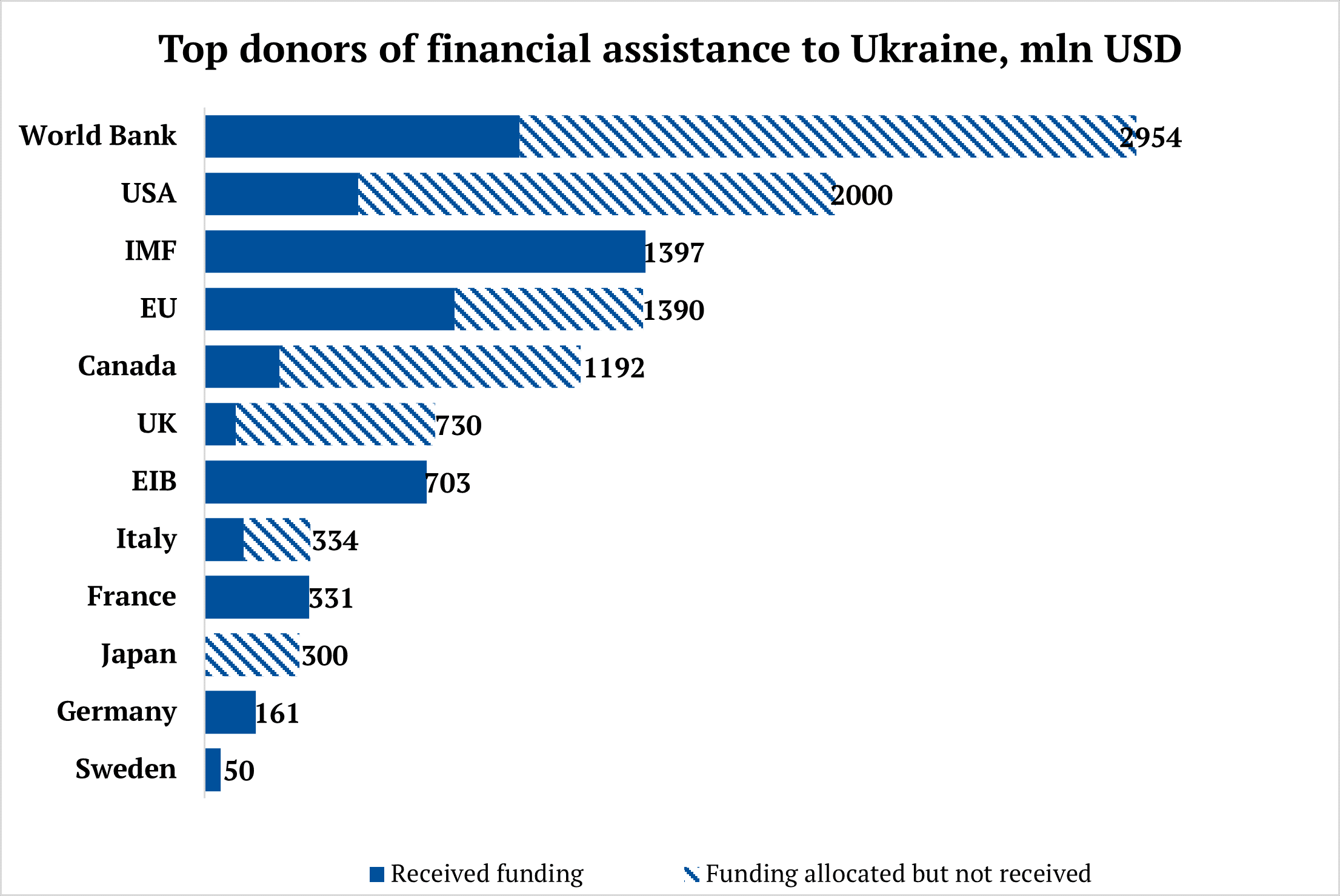
Source: Dragon Capital, Kiel Institute, Ministry of Finance, CES calculations as of May 9, 2022.
Financial aid can come in three types: loans, loan guarantees, and grants. But it is time for Ukraine to look at it not only from the perspective of urgent emergency needs, but also through the prism of long-term fiscal sustainability.
Grants are the most desirable because they do not increase Ukraine’s debt burden. About 36 percent of the aid provided by Ukraine’s partners is grant funding. Grant funding comes to Ukraine from the World Bank, the European Investment Bank, the IMF, already mentioned the U.S. and U.K., and Italy, which took decisions and transferred funds to Ukraine within days after the full-scale invasion.
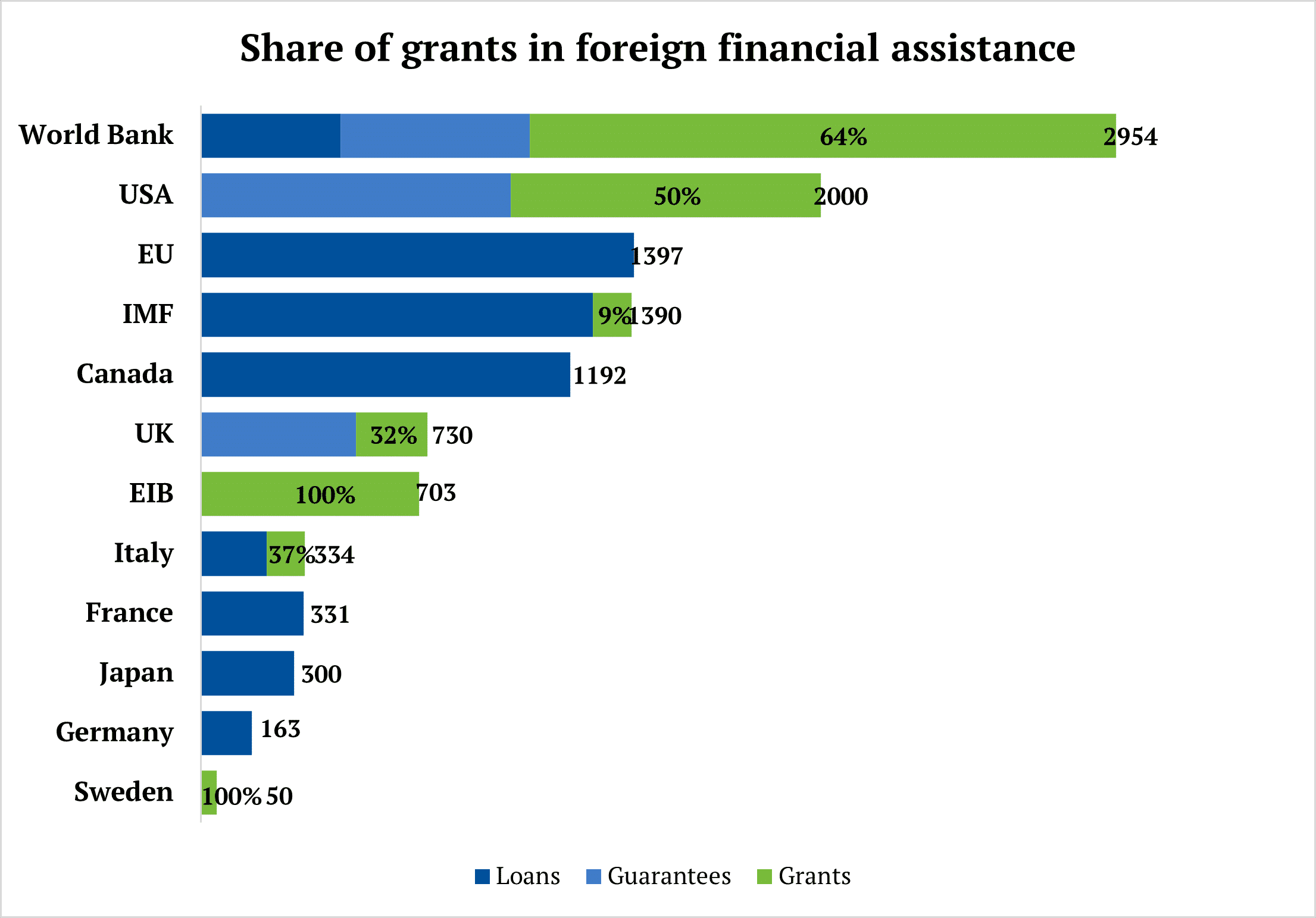
Source: CES estimates as of June 9, 2022
Financing in the form of credit guarantees must be from three partners: the World Bank, the United States and Great Britain. At the same time, these two countries belong to those from which financial assistance comes to the Ukrainian budget slowly. However, they, like Japan, that is also included in this list, provide us with significant military assistance.
This cannot be said about Germany, which not only does not dare to provide Ukraine with heavy equipment, but also lags behind among the major financial donors in terms of the volume of promised support.
The other countries that provide us with significant financial assistance do so in the form of loans. Of particular note is Poland, central bank of which opened a $1 billion swap line, which increased the stability of the National Bank of Ukraine.
The large share of credit financing (in the form of loans and guarantees), on the one hand, is a positive signal: this means that creditors believe in Ukraine’s victory – no one would lend to a country that is about to disappear from the political map. On the other hand, we still need to repay the loans – it will put an extra burden on the nation, which will be busy rebuilding the country after the war.
Foreign financial support is crucial for Ukraine. It ensured the stability of the budget system and the government’s ability to respond quickly to challenges during the most dangerous initial period of the war.
Nevertheless, we must realize that it is only a bridge to developing our resilience under the new conditions. We should already be reviewing revenue projections, adjusting expenditures, and looking for ways to make the functionality of the state consistent with the new military and post-war environment. No matter how much help we receive from partners, inaction in this area will carry risks for Ukraine’s postwar growth.
The material was published on Ekonomichna Pravda in Ukrainian.