
Testing the limits of resilience: Ukraine’s wartime public finance
Origin: Friends of Europe.
Although it has recently become customary in European public debate to applaud Ukraine’s resilience amid unprecedented hardships, this resilience is far from infinite. Continuing to overlook it would be a serious miscalculation. Ukraine’s wartime public finance analysis adds numbers-driven clarity to this picture.
Russia shows no signs of war fatigue or willingness to retreat, continuing on-the-ground attacks and aerial bombardments. Ukraine is unable to outmatch the war effort, stretching its manpower, ammunition and financial resources. Mobilisation has drained key qualified personnel from enterprises, the energy system already lacks spare parts for repairs and the frontline is gradually moving westward.
The current balance is very uncertain. Since the onset of the full-scale invasion, Ukraine’s military expenditures have increased tenfold compared to pre-war times – but then has plateaued.
Figure 1. Monthly dynamics of expenditures in the security and defence sector over the past three years.
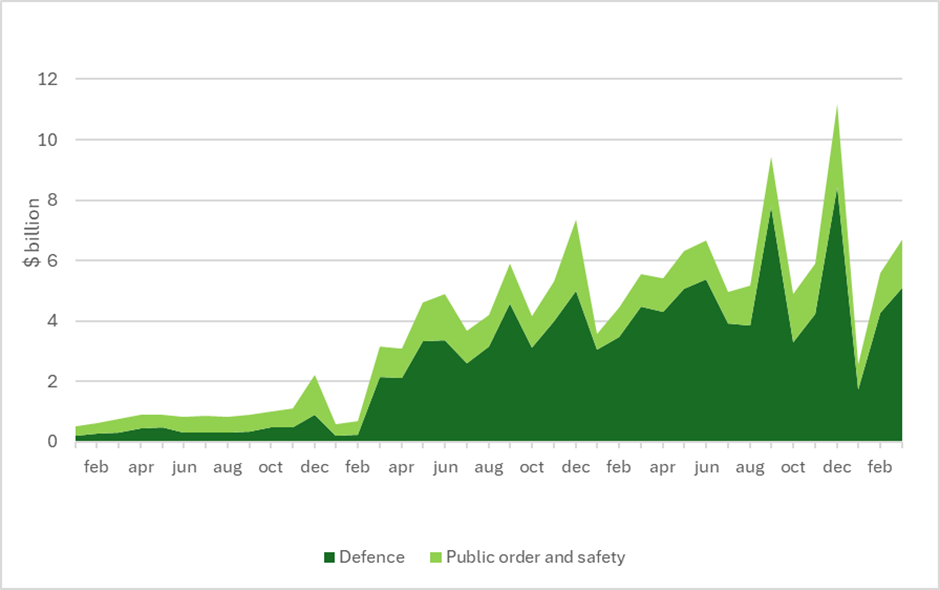
From Ukraine’s side, the military funding has reached its limit: nearly all the budgetary inflows generated domestically are being directed to defence efforts. The feature of Ukraine’s public military spending is that it cannot be financed from Western aid sources, which are strictly earmarked for civilian needs. Only the funds generated by the Ukrainian government domestically or borrowed from local banks can be used to fund the military salaries, procurements of weapons and forage and other war-related needs.
Meanwhile, the country is gradually losing land, soldiers’ lives and economic potential in terms of electricity generation, business activity and human capital
Locally-generated budget inflows effectively put a cap on the level of defence expenditures. At the same time, the other expenditures are covered by international aid. In 2023, general government sector expenditures totalled $135bn, from which approximately half, or $68bn, was used for defence purposes[1] and covered internally. This amount includes some of the in-kind military aid[2] and all kinds of other military expenditures, like salaries – roughly one-third of the total military spending – supplies and weapons procured by Ukrainian procurement agents.
Figure 2. Approximate illustrative* distribution of inflows and expenditures of the general government sector in 2023
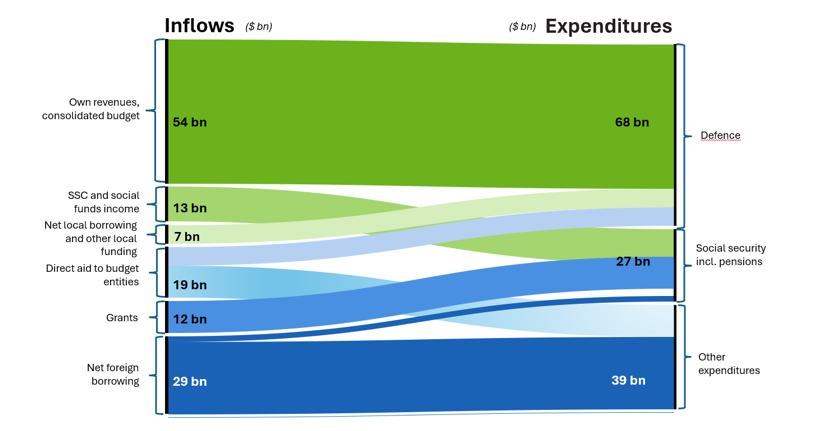
With more resources available, Ukraine could procure more weapons from Ukrainian drone producers, recruit and train more soldiers and elevate the defence effort in general. Meanwhile, the country is gradually losing land, soldiers’ lives and economic potential in terms of electricity generation, business activity and human capital.
Using frozen Russian assets to deliver the victory would be a morally just and logical step
The policy options here are limited, however the following could be recommended:
- Local tax revenueshave nearly peaked and can only be slightly increased. The government’s efforts, coupled with donor-funded fiscal stimulus equivalent to roughly a quarter of GDP, managed to keep the economy afloat and the tax collection gathered pace in 2023. The budget revenues, sourced domestically, are already higher than the pre-war level, reaching 37.4% of GDP versus 37% of GDP in 2021. However, businesses face shrinking demand and funding challenges and the government’s ability to reform tax administration and incorporate the shadow economy remains uncertain. While some increase in tax rates for compliant businesses looks unavoidable, it risks further damaging economic activity, especially in the war-affected regions.
- Local borrowing is an expensive and very short-term source of funding. Given the rates of 15% to 17% per annum on the one to three year local bonds, the government has primarily opted for the rollover of the existing bonds rather than increasing local borrowing to avoid additional interest payment pressures and the need for significant fund accumulation for bond redemption in the near future.
- More non-military financial aid from abroad would translate into fiscal stimulus and stronger economic growth. These inflows will boost the tax base with immediate effect and dampen some of the most negative consequences of war, such as poverty, loss of years of education, physical and mental health problems on the social side and infrastructure and logistics for business development on the economic side. The non-military expenditures have been virtually frozen since 2022, with only a few exemptions. Adjusted for inflation, the total non-military expenditures now are at approximately 85% of the pre-war level. The increase of the financial inflows, therefore, would help not only address the most pressing issues but also add to budget revenue, indirectly paying for the defence efforts. But it ideally should not create an additional debt burden – a good example of such aid was the grants from the US government in 2022 to 2023.
- More direct military aid is necessary and vital for Ukraine’s survival and eventual victory in the war. It is important to boost it quickly and significantly because of other resource depletion. Also, finding a way to procure weapons from Ukrainian producers is relevant. The latter is important against the background of the weapons deficit worldwide and the spare capacities of Ukrainian producers, as well as the need to develop the Ukrainian defence industry in the long run, thinking of the country’s strategic positioning as Europe’s eastern outpost.
- Using frozen Russian assets to deliver the victory would be a morally just and logical step. The audit of the funds available, following the legal procedures already developed by internationally renowned lawyers and execution as soon as possible would reduce prolonged suffering, minimise damage, weaken the aggressor and hasten peace in Europe.
While these actions may be effective in the long run, the need for immediate action is urgent. The international community must move beyond minimal support efforts and fully conceptualise Russia’s defeat and Ukraine’s victory. This vision should be backed with the necessary financial means to shape the future of Europe and the world.