
What will encourage Ukrainian refugees to return home
Ukrainians are ready to return even to a region other than their native one if supported. What did one of the latest polls show?
After the outbreak of the full-fledged war of aggression, millions of Ukrainians were forced to leave their homes and go abroad. A large number of them still stay outside Ukraine.
Who are these people, how do they live, and what are their plans for the future?
The Centre for Economic Strategy and the Info Sapiens research agency surveyed Ukrainians who have moved abroad to find out.
Who are the Ukrainian refugees?
According to the survey, half of the Ukrainians who have moved abroad are children. Among adults, the majority (83%) are women, mostly (42%) aged 35-49.
This is not surprising, as women left the country for the safety of their children, while most men are prohibited from leaving during martial law.
Among the refugees interviewed, the largest number of refugees are from Kyiv (14%), Dnipro (12%) and Kharkiv (11%) regions.
At the same time, the largest share of the population left Zaporizhzhia region (23%), as well as Kyiv and Kyiv region (about a fifth of the pre-war population). Between 15% and 20% of the population left Dnipro, Mykolaiv and Kherson oblasts.
Most Ukrainian refugees have lost their income due to the war.
For example, by 24 February 2022, only 4% of them lacked money for food, while 8% had enough money for food only. Now, 12% do not have enough money even for food, and 28% have enough for food only.
Most adult refugees (70%) have a university degree. This figure is much higher than the share of people with higher education in Ukraine (29%) and the EU (33%).
On the one hand, it will be easier for refugees to find work in the EU, but on the other hand, this may lead to a shortage of highly qualified specialists in Ukraine.
Living conditions of Ukrainian refugees
Most Ukrainian refugees reside in Poland (38%), Germany (20%), the Czech Republic (12%) and Italy (6%). In these countries, they can obtain temporary protection status, which gives them the right to reside, work, and access healthcare and education systems.
However, each country independently decides what social benefits and privileges to provide to Ukrainians and how to adapt them to live in society.
Germany has the most generous social benefits: Ukrainians can receive monthly unemployment benefits (about 400 euros), additional payments for children (285-376 euros per month, depending on the child’s age) and rental subsidies.
In Poland, the only type of regular assistance refugees can receive – is child benefits (approximately EUR 100 per month).
In the Czech Republic, Ukrainians can only receive a one-time allowance (about 200 euros). In Italy, the allowance is €300 per month and is paid for three months.
As a result, 56 percent of Ukrainians in Poland and 50 percent in Italy do not have enough money to meet their basic needs. In Germany, 76% of Ukrainians have enough money to meet their basic needs, and 14% do not deprive themselves of anything.
Different countries’ policies lead to different degrees of adaptations of Ukrainians to the labour market. Only 15% of refugees are employed in Germany, and in Italy – 12%. In Poland, 41% of Ukrainians are employed, and in the Czech Republic – 47%.
The low percentage of employed refugees in Germany is linked to government policy: Ukrainians are encouraged to take language courses before looking for work. In Italy, this figure is related to high unemployment and the need to provide documents confirming language skills and qualifications.
Will refugees return to Ukraine?
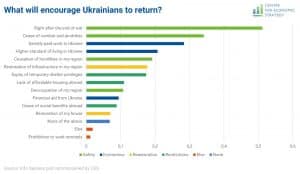
50% of Ukrainians “definitely plan” to return home, while 24% “rather plan” to return. However, the longer the war continues, the more people will adapt to life abroad and not return to Ukraine.
The main incentives for returning are the complete end of the war (51%) and the absence of battles and air strikes in their home region (34%).
Economic factors are also important: the opportunity to find a well-paid job (28%) and a higher standard of living in Ukraine (20%).
At the same time, adult refugees may return to Ukraine, while their children of secondary school age will remain abroad.
Overall, 40% of refugees want their children to study abroad.
The demographic situation in Ukraine was difficult even before the war: the population was ageing, and mortality was higher than the birth rate.
The non-return of many refugees with higher education and their children poses a significant threat to the economy.
According to the experts who conducted the survey, the annual losses of the Ukrainian economy from the non-return of refugees will range from 2.6% to 7.7% of pre-war GDP.
Recommendations
The government should take the following steps to return as many Ukrainians as possible after the war.
The first is to cooperate with EU states to return Ukrainians. Kyiv needs to convince its European partners that the return of refugees is another form of assistance to the country.
The more people return, the faster the economy will grow. This will also contribute to security in Europe, meaning that the EU will need to spend less money on rebuilding Ukraine.
The second is the rapid post-war reconstruction of the affected regions. People who fled abroad from the cities destroyed by Russia have no place to return to.
Even if their homes have been preserved, the lack of infrastructure can make a city uninhabitable. Therefore, fast and transparent reconstruction should facilitate the return of Ukrainians home.
The third is to provide assistance to refugees from the affected regions while reconstruction continues.
The survey shows that Ukrainians are ready to return even to a region other than their native one if they receive support, either in cash or in the form of subsidised housing in safer areas.
The fourth is assistance in finding a job in a safer region and re-qualification courses. The opportunity to find a well-paid job in Ukraine is an essential incentive for return.
To this end, state agencies, such as the Employment Service and EU bodies, could fund retraining courses in relatively safe regions of Ukraine.
The fifth is the opening of the EU labour market to Ukrainians after the war. This would mean that Ukrainians who left for the EU because of the war would not need to hold on to their residence permits in the EU.
Knowing they can re-enter the EU anytime, these people will be more inclined to return to Ukraine.
Methodology.
The survey was conducted in November-December 2022 among Ukrainian adults (over 18 years old) living abroad (except for those in Russia and Belarus).
For other countries, quotas were used for the number of refugees interviewed in each country.
Respondents were randomly selected among Kyivstar subscribers who were abroad to ensure the representativeness of the survey.
The selected respondents received a text message with a link to the survey. A total of 1,003 respondents were interviewed.
Dariia Mykhailyshyna, CES Advisor and PhD student at the University of Bologna