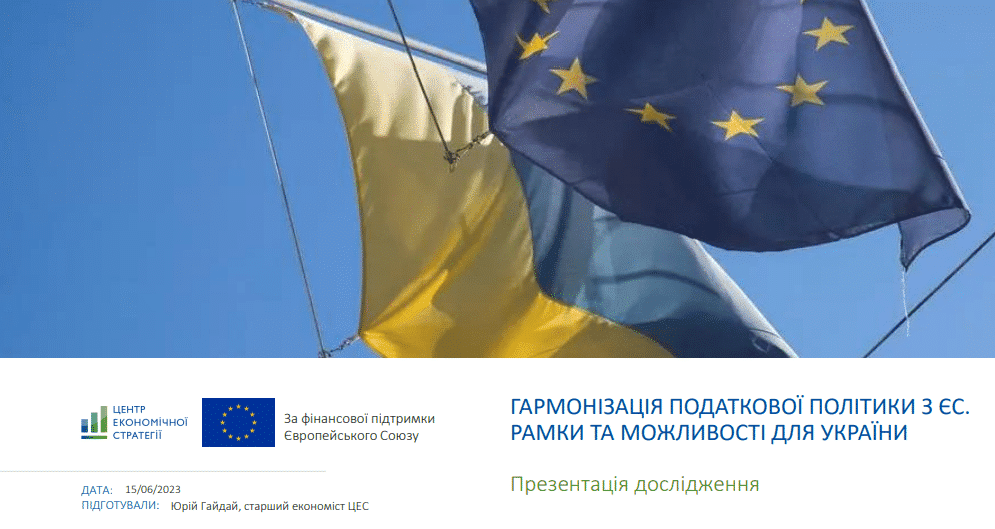
Harmonising the tax policy with the EU. The framework and opportunities for Ukraine
The main goal of harmonisation of the tax policy of the EU Member States is to ensure the functioning of the single internal market of the EU – a territory without internal borders, where the free movement of goods, persons, services and capital is ensured.
Non-harmonised indirect taxes, which at their core are a markup to the consumer’s final price, can significantly impact the single market. They create barriers to the movement of goods and services, distorting market incentives and competition.
Therefore, the European Commission coordinates and harmonises the policies of Member States regarding indirect taxes, namely value-added tax (VAT) and excise duties. The main instrument for this is the relevant European Union Directives establishing general principles and framework for the application of indirect taxes, as well as individual derogations, or exceptions from the general framework, allowed to EU Member States under appropriate circumstances, and mechanisms for harmonising such exceptions and derogations.
Practical implementation of indirect taxation within the framework of harmonised standards and tax administration remain the authority of EU Member States.
Policy on direct taxation (income, capital, property) remains the responsibility of EU Member States. The European Union establishes only separate harmonised standards for the taxation of enterprises and individuals in view of the principles of the EU single market. Thus, double taxation of the income of individuals within the EU would contradict the principle of free movement of human capital.
We reviewed the current system of VAT rates, mechanisms for obtaining VAT exemptions and derogations from general rules that may be applied during the transition period after the state’s accession to the EU, as well as those applied by Member States.
The note contains an overview of special schemes provided in the EU for small enterprises and farmers, in particular, the flat rate mechanism, which has no analogue in the current Ukrainian tax system.
The note also describes the general rules of the excise tax system and specific directives establishing the framework for harmonised excise taxes on alcohol, tobacco, fuel and energy resources, in particular, simplifications for small producers of alcoholic beverages that may be applicable to Ukrainian businesses.
The European VAT system is currently undergoing a reform aimed at adapting to the digital economy, in particular, expanding the role of digital platforms that act as intermediaries between suppliers and consumers and increasing the volumes of digital services.
Among the key changes is the introduction of harmonised Digital Reporting Requirements (DRRs) and standardised electronic invoicing. Another important change is the expansion of mechanisms that allow VAT payers supplying goods and services in more than one Member State to register as a VAT payer only once, through the One-Stop Shop. European VAT is also moving towards a definitive system where all transactions are taxed at the place of delivery.
The overview includes references to key legislative instruments, regulations and studies and can be a starting point for delving into specific areas of regulation. Given Ukraine’s status as a candidate for EU membership, it is especially important that the widest range of Ukrainian policymakers, experts and entrepreneurs have a systematic understanding of the European harmonised system of indirect taxes and the vector of its reform – for easier integration into the EU single market on the conditions that will ensure rapid development of Ukrainian business, economy, and growth of the welfare of Ukrainians.
The research was carried out with the financial support of the European Union. The content of the research is the sole responsibility of the Centre for Economic Strategy and does not necessarily reflect the views of the European Union.

Explore more