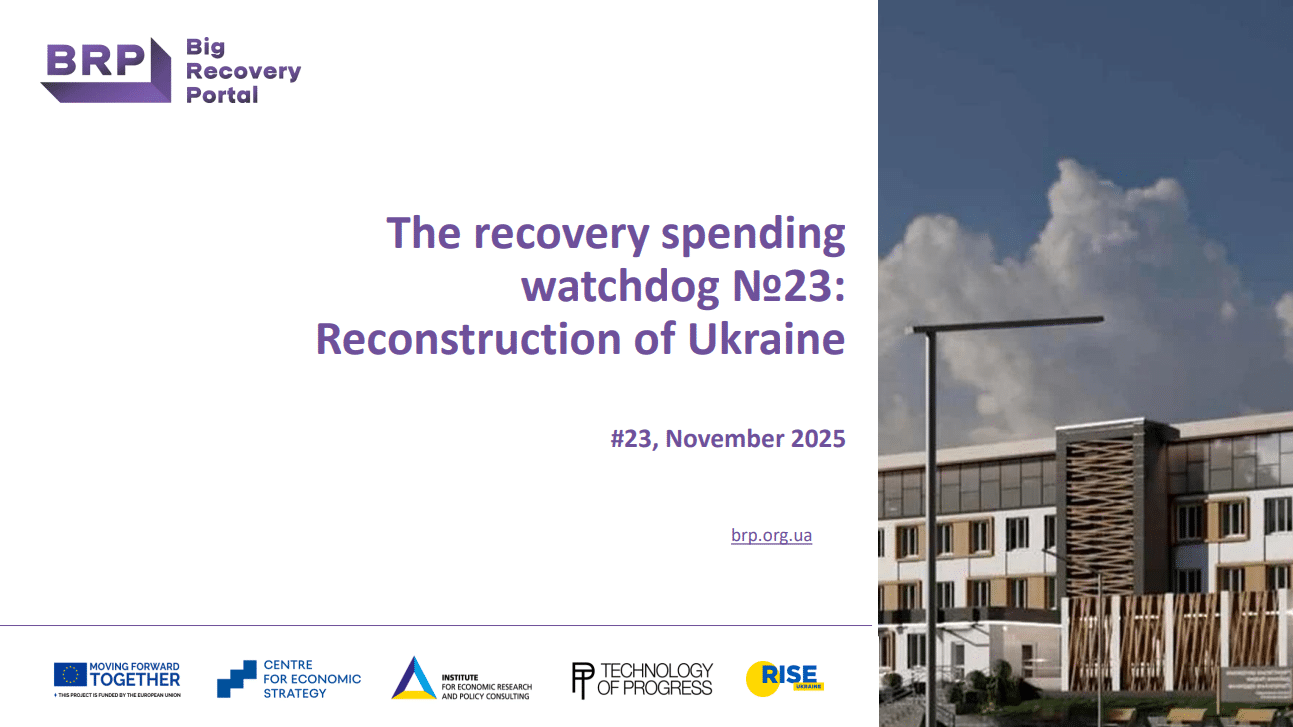
The recovery spending watchdog №23: more than three years of Ukrainian recovery
Research
| 7 November 2025
Since June 2023, the Centre for Economic Strategy, the Institute for Economic Research and Policy Consulting (IER), and “Technology of Progress” NGO have been working on the project “The Recovery Spending Watchdog”, funded by the European Union.
The project aims to create an independent system for monitoring budgetary and donor funds spent on reconstruction, analysing these expenditures, and engaging the public in overseeing the recovery process.
In 2023–2024, the volume of construction procurements amounted to about UAH 300 billion (~ $7–8 billion) annually, or ~4% of GDP. In 2025, the same volume is very likely to be reached.
Among the largest construction procurements over the three years (excluding defence procurements, including the construction of fortifications) are: road repair and maintenance in various regions, water pipelines for Kryvyi Rih, Marhanets, and Mykolaiv, construction of the Syretsko-Pecherska metro line in Kyiv, restoration of educational and healthcare facilities, as well as the protection of energy infrastructure. Almost half of the local budget expenditures on reconstruction are in frontline regions due to severe destruction. The main reconstruction priority funded by local budgets is housing, while the Restoration Agency procures project management services financed by IFIs.
Over three years, 46% of damaged healthcare facilities and 28% of educational facilities have been restored, and more than $1 billion has been allocated for housing damage compensation. At the same time, this is significantly less than the funding needs estimated in RDNA4 ($193 billion for restoring housing, education, healthcare, social, and municipal infrastructure).
Reconstruction is a key component of the country’s resilience despite high security risks. To ensure that the state rebuilds more cheaply, efficiently, and with higher quality, it is necessary to:
- Strategic planning of reconstruction — prioritizing facilities with regard to local community interests, stable and even financing, and ensuring continuity of procurement;
- Improving procurement procedures and oversight, conducting procurements through professional purchasing bodies, adopting a risk-based monitoring approach, and unifying classifiers and terminology;
- Increasing competition in procurement, including opening cost estimates.
Greater availability and openness of data, specifically on reconstruction, will enable society to oversee this process.
Key findings in November 2025:
- Barrier-free accessibility is becoming a priority in government policies: new standards aligned with international ones have been adopted.
- The government has allocated the State Fund for Regional Development sufficient resources to sustain 48 projects: they must be completed by the end of the year.
- Procurement regulations undergo amendment and clarification: approaches to procurement funded through the Ukraine Facility have been approved.
- In September 2025, the number of construction procurements increased compared to September of last year, but the total value of procurements was slightly lower than last year. The largest procurements in September include the protection of energy facilities, road maintenance in Mykolaiv Oblast, the construction of a border checkpoint with Moldova, and a school shelter.
- Due to shelling, the number of applications for compensation for damaged and destroyed housing is increasing. Despite ongoing destruction, medical and educational institutions are gradually being restored.
This release has been prepared within the framework of the project “The Recovery Spending Watchdog”, funded by the European Union. The project is a joint initiative of the Centre for Economic Strategy, the Institute for Economic Research and Policy Consulting (IER), and “Technology of Progress” NGO. All project participants are members of the RISE Coalition.
Explore more