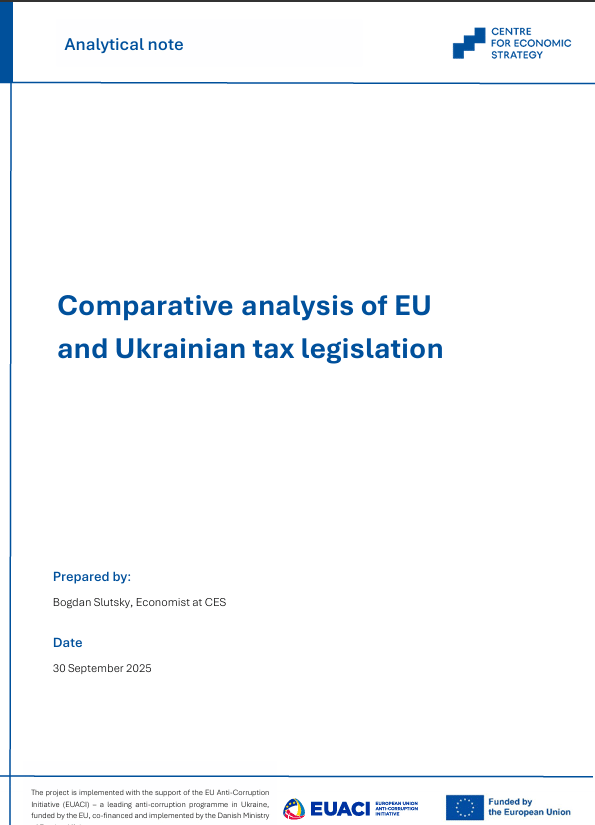
Tax Legislation in Ukraine and the EU: A Shadow Report
Ukraine is gradually bringing its tax legislation closer to European standards, but this process is still incomplete and requires further alignment.
- In the VAT area, the basic rate and overall architecture follow European logic, but reduced rates and the list of exemptions go beyond what is permitted under EU rules. VAT refunds for non-residents, the distinction between zero-rated and exempt transactions, and the detailed rules on the place of supply of services remain unresolved issues.
- Excise policy is converging with the EU’s minimum levels according to a clear schedule; however, classifications of alcohol and tobacco products are still not harmonised. Differences persist in the logic of tax liability, and integration into the EU excise movement control system remains incomplete. In the future, the regulation of new nicotine-containing products will require implementation in line with the new European framework.
- In direct taxation, transparency standards and transfer pricing control have already been introduced, but a number of key directives — on corporate structures, taxation of passive income, tax-neutral reorganisations, and the global minimum tax — still await implementation.
- International cooperation is expanding: Ukraine has joined automatic exchange of financial information and country-by-country reporting for multinational companies. At the same time, it is necessary to complete the adaptation of transparency directives, ensure connection to secure EU networks, and align reporting with European standards.
- The institutional capacity of tax authorities is improving thanks to digital transformation and the National revenue strategy, but major challenges remain, including stable financing, staffing, and compatibility of IT solutions with European systems.
- Anti-corruption efforts in the tax sphere have been strengthened through the automation of certain processes, yet significant risks persist in VAT, excise duties, and tax audits. Limited staff incentives, complex rules, and the continued use of discretionary decisions pose additional threats. Further progress will require not only technological solutions but also institutional reforms to ensure the sustainability of changes.
Overall, Ukraine has a clear roadmap and strategic direction. Ahead lies the complex task of completing harmonisation, including politically challenging decisions that combine legislative alignment, digital integration, and the strengthening of human and institutional capacity. Only a comprehensive approach will ensure real compatibility between Ukraine’s tax system and the EU internal market.
This project is implemented with the support of the European Union Anti-Corruption Initiative (EUACI) — the leading anti-corruption programme in Ukraine, funded by the EU and co-financed and implemented by the Ministry of Foreign Affairs of Denmark.
The views and opinions expressed in this material do not necessarily reflect those of EUACI, the European Union, or the Ministry of Foreign Affairs of Denmark.
Other CES research on this topic is available via the link.
Explore more