Migrants and poverty in Ukraine: demographics, labour market and social challenges
“What’s up with the economy?” is a weekly podcast by the Centre for Economic Strategy in collaboration with Hromadske Radio and supported by PrivatBank.
Hosts Anhelina Zavadetska and Maksym Samoiliuk speak with experts, entrepreneurs, analysts, and government officials about the current state of Ukraine’s economy.
In this episode, we discuss how many Ukrainians actually live on government-controlled territory today, why measuring population during wartime requires mobile operators and Big Data, how poverty has grown from 22% to 30%, and what Ukraine’s demographic future looks like — from labour migration and regional shifts to working past 70 and the persistent shortage of blue-collar workers.
The guest is Ella Libanova, Academician and Director of the Ptoukha Institute for Demography and Social Studies of the National Academy of Sciences of Ukraine.
We have summarised the main points of the conversation with expanded direct quotes:
How many Ukrainians are actually in Ukraine?
Measuring a country’s population during a full-scale war is a task that sits somewhere between science and detective work. Ella Libanova highlights that counting a precise figure is impossible right now.
“We think it’s 29–30 million. Approximately. The question is that measuring this accurately right now is absolutely impossible. God willing, we first win the war, then in two years we conduct a census — then we’ll understand how many of us there are.”
Libanova underscores that the last census Ukraine conducted was in 2001 — meaning the country has gone a quarter of a century without official data on who lives here, how old they are, where they were born, or how many children they have raised.
In the absence of a census, Ella Libanova’s Institute has stepped in to fill the gap.
“We are helped enormously by mobile operators — specifically three: Kyivstar, Lifecell, and Vodafone. There is a methodology that has been developed, and we receive data from these operators. In addition, we analyse the situation on the labour market using Big Data — what supply is available on the labour market. The idea is to use several methods and arrive at approximately the same figure.”
Poverty has grown — and international aid is the only reason it hasn’t grown more
One of the starkest findings Libanova raises is the expansion of poverty. Before COVID-19, Ukraine’s poverty rate stood at roughly 22–23%. Now, the Institute estimates it has reached around 30%.
“If we hadn’t received help from Europe… We simply wouldn’t be here talking. Let’s remember: World War I — Germany was occupied and collapsed because of economic problems. Because the budget simply couldn’t bear the load. I’m sorry, but we would have had the same thing.”
She acknowledges, however, that the data on which specific population groups have fallen into poverty is incomplete — a direct consequence of the absence of proper statistical tools during wartime.
Ukraine needs migrants — even if it’s not a comfortable idea
The demand for workers remains high, and the massive scale of the post-war “Marshall Plan” will make sourcing domestic labor impossible. Migrants engaging 一 it is a practical necessity.
“Even today, despite structural and persistent unemployment that exists, we have an unmet demand for labour. And after the war, I absolutely believe there will be something like a Marshall Plan. And many structures are working on this today — including the World Bank. Honestly, this plan is already prepared. I know for certain, because I participated in its preparation. And the Marshall Plan assumes very significant growth in demand for labour. So where will we get it from?”
Libanova anticipates that construction workers will be the most immediately needed category. But she draws a more interesting picture of a second wave: engineers, specialists, and technically skilled workers who will come not for welfare benefits — which Ukraine won’t be able to match against Germany or the Netherlands — but for the opportunity to build something.
Too many graduates? No — too little respect for skilled trades
One of the podcast’s more provocative exchanges concerns the perception that Ukraine has “too many” people with higher education. Libanova flatly rejects the premise.
“Higher education and education in general is not about the labour market. It is about human development. It’s about a person having analytical abilities, being able to critically evaluate information. And that, by the way, is very important now — because distinguishing what comes through the internet, separating the wheat from the chaff, is very hard. And for this you need education and the ability to work with information.”
She distinguishes between education (developing the human being) and skill (qualifying for a specific job), quoting the first female president of Harvard: a Harvard diploma is not about your first job — it’s about your sixth. An educated person who loses one position will find another.
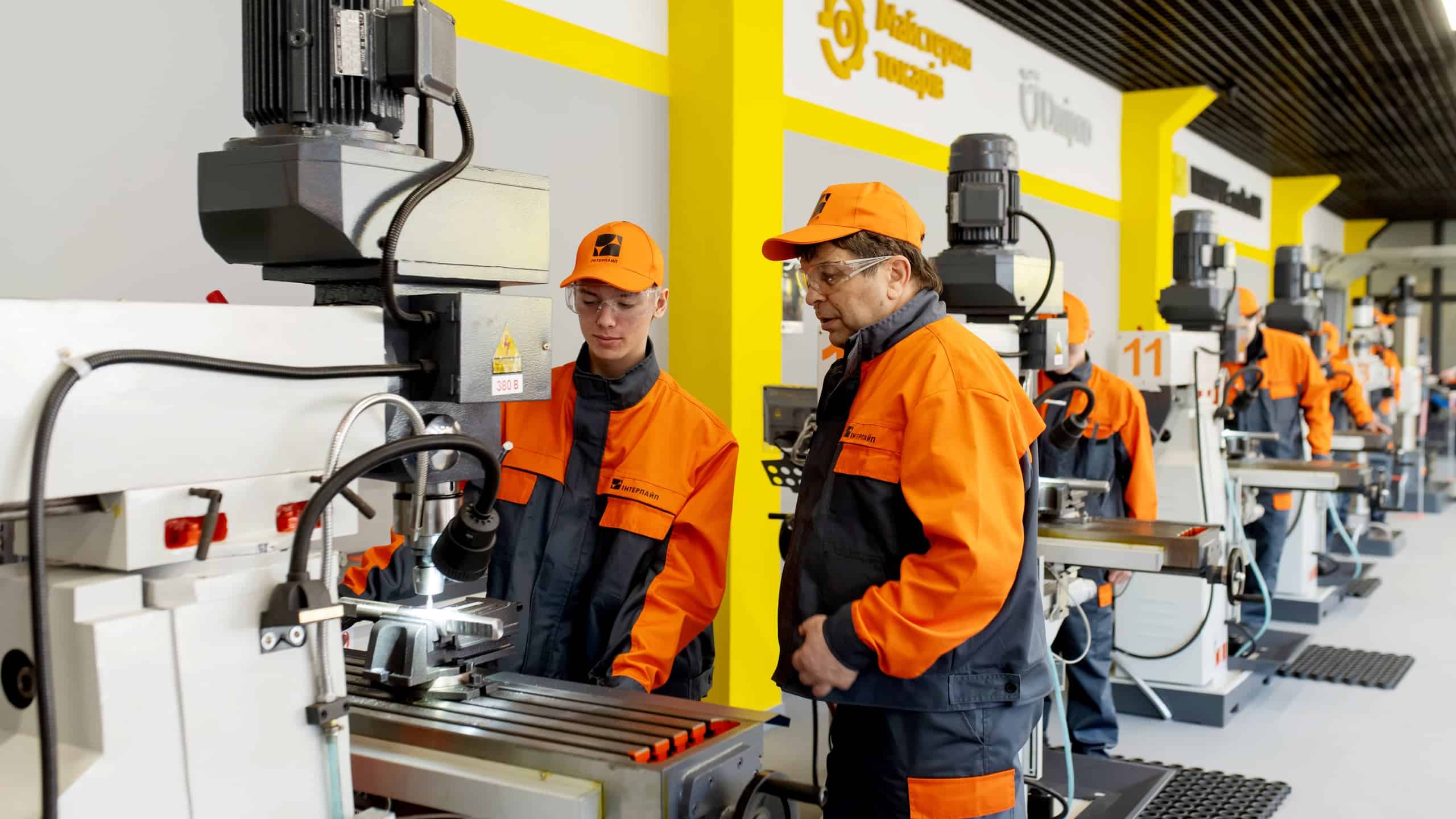
The real problem, Libanova argues, is not too many graduates — it is the persistent social stigma against skilled trades and blue-collar work.
“We have inherited from our great-grandparents the idea that jobs not requiring higher education — non-office jobs — are ‘dirty’ work. Work that is not respected in society. Office clerks are what society respects. And this needs to be broken.”
She points to a study from 2015–2016 in which 90% of young Ukrainians said they would choose university over vocational college even if the college guaranteed higher employment rates and equal or better pay. The aspiration to an office career runs deep. But she sees signs of change.
“Just ask parents who used to have plumbers over to their city apartments. First of all, they were always tipsy — never saw a sober one back then. And second, look at how they were dressed. Then look at who shows up today. It’s a completely different breed of people.”
Working past 70: Not a law, but a reality
Centre for Economic Strategy Director Hlib Vyshlinsky has argued that Ukrainians may end up working until 70 or 75. Libanova broadly agrees with the direction — but with important nuance.
She points out that raising the retirement age by decree is not necessarily the right instrument. Before the war, Ukrainian men who reached 60 had, on average, only about 14 more years of life expectancy. Pushing retirement to 65 or 70 in that context risks leaving people with little or no retirement at all.
“I don’t see the prospects for raising the retirement age right now. There is another issue. Many people who reach 60 and are engaged in non-physical labour — physical labour is a separate question — can and want to continue working. This needs to be taken into account and policy needs to be shaped accordingly.”
Libanova stresses instead that the shift will happen de facto, not de jure: people will work longer because they want to, because the economy demands skilled non-physical labour, and because services increasingly free up time that manual labour once consumed.
“There is a term in Europe — the ‘silver economy.’ They understand, just as I say, that the problem of demographic ageing is not only Ukraine’s problem. They understand this and try to engage as many older people as possible in work.”
She also points to a key policy lever that avoids the political minefield of a formal retirement age increase: raising the minimum insurance contribution period. The effect, she notes, would be identical — people would work longer — without requiring a headline change to the retirement age itself.
Libanova also challenges the idea that older workers are a burden. Their human and social capital, she argues, is often superior to that of younger cohorts — particularly in terms of professional reliability, institutional knowledge, and the ability to operate independently in complex environments.
Explore more