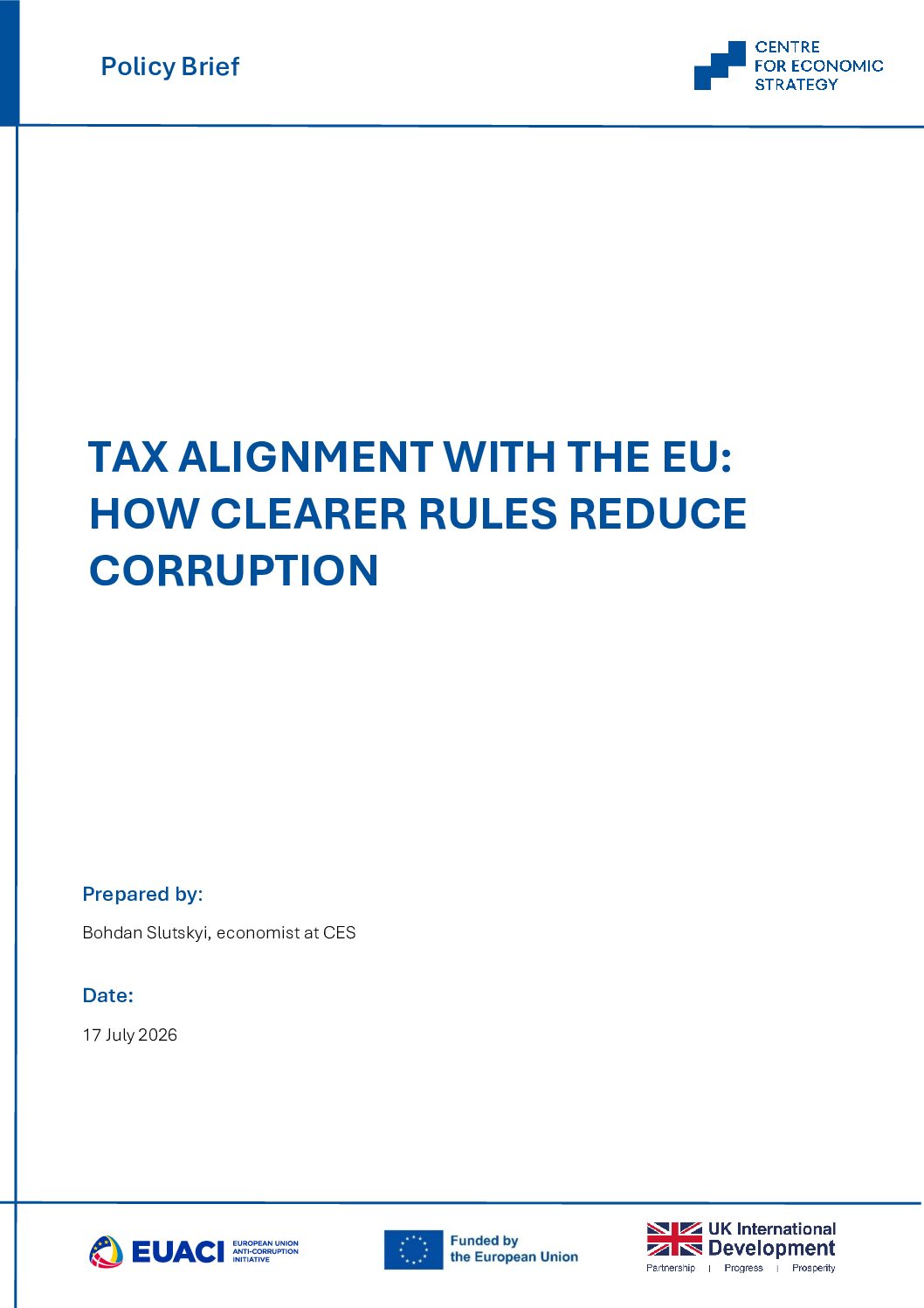
Tax alignment with the EU: How clearer rules reduce corruption
Ukraine’s status as a candidate for EU membership has changed the logic of its tax policy. Whereas previously the Association Agreement , with its selective list of EU acts (primarily directives), served as a benchmark, Ukraine must now ensure compliance with the full scope of the EU acquis. The deadline for alignment is set for 1 January 2028, and the main roadmap is the National Adaptation Programme, adopted by the Cabinet of Ministers of Ukraine on 1 April 2026. Chapter 16 ‘Taxation’ covers indirect and direct taxes, administrative cooperation, the automatic exchange of information, as well as the capacity and integrity of the tax administration.
This study examines the quality of tax legislation as an independent factor in corruption risks and assesses how alignment with the EU acquis under Chapter 16 affects these risks. To this end, we combined international comparisons of regulatory quality and perceptions of corruption, microeconomic data on the link between regulatory burden and unofficial payments, an assessment of the actual state of legislative alignment, and an analysis of specific draft laws. Main conclusion: the anti-corruption effect of European integration is not ensured by the mere adoption of regulations, but by their quality and effective procedures; therefore, tax alignment should be assessed primarily in terms of the clarity, simplicity and predictability of regulation.
Key findings and recommendations:
- Tax alignment with the EU should be assessed based on the quality of the rules. A strong link between regulatory complexity and corruption is confirmed by numerous international studies — ranging from cross-country comparisons to analyses of business data; however, existing assessments do not provide grounds for attributing this to a clear-cut causal relationship. Therefore, every piece of legislation under Chapter 16 ‘Taxation’ must be assessed for the clarity of its criteria, the number of exceptions, the simplicity of procedures and the proportionality of penalties.
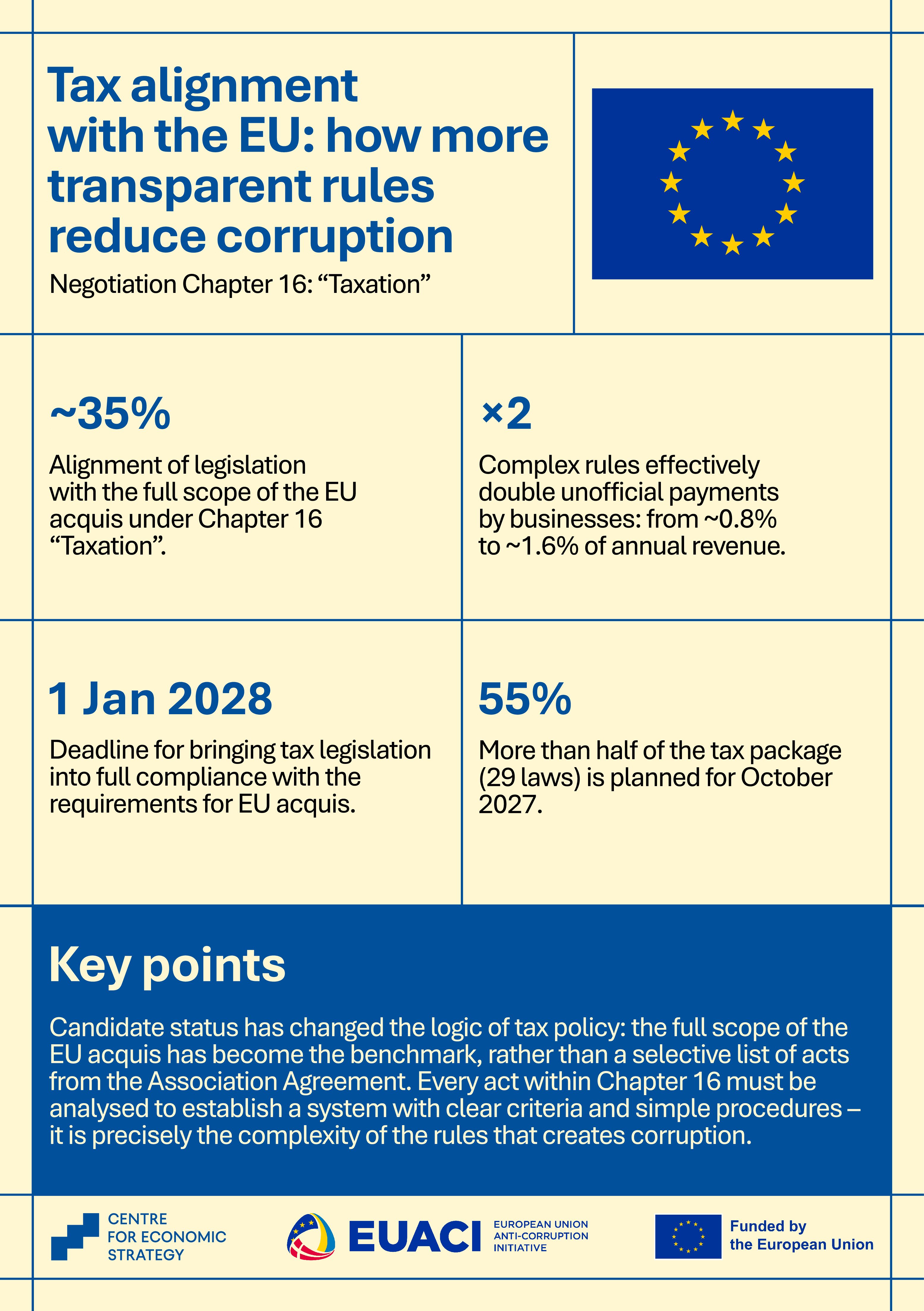
- Move from the logic of the Association Agreement to full alignment with the EU acquis. Ukraine has implemented 90% of the tax provisions of the Agreement for the period 2014–2025 , but alignment with the full scope of the acquis under Chapter 16 stands at around 35%. The shortfall is spread fairly evenly across all components of Chapter 16, rather than being concentrated in any single area: administrative cooperation and data exchange – 31%; indirect taxation – 35%; direct taxation – 36%. Further alignment must be based on the entire body of EU tax law, rather than on a selective list.
- Review the adaptation timetable and ease the burden on the final stage. More than half of the tax package under the National Adaptation Programme is scheduled for October 2027 — very close to the final adaptation deadline of 1 January 2028. This creates a risk of regulations being adopted in haste without proper preparation of procedures, IT systems and administration. The most complex changes need to be prepared well in advance, together with technical solutions, reporting forms, control algorithms and implementation practices.
- The launch of a functioning procedure should be regarded as a criterion for success. Legislation changes practice when taxpayers have a clear course of action and the supervisory authority has a standardised algorithm. Monitoring of the adaptation process should record not only the adoption of legislation, but also the launch of digital tools, data exchange channels and procedures that are actually used by taxpayers and the tax authority.
- Establish mechanisms to ensure the sustainability of reforms following EU accession. The experience of new EU Member States shows varying trajectories following accession. Latvia, Lithuania and the Czech Republic continued with institutional changes, whilst Hungary, Slovakia and Bulgaria lost some of their earlier gains. The sustainability mechanism must be specific and in place before accession: irreversible digital procedures (e-Excise system, automatic data exchange), autonomy and sustainable funding for the State Tax Service, compatibility of IT systems with the EU, protection for whistleblowers, and monitoring based on whether procedures are actually working, rather than merely on the fact that regulations have been adopted. It is precisely these safeguards that have sustained the results in Lithuania and Latvia and have been dismantled in countries where the incentive for accession has faded (Hungary, Bulgaria).
This project is supported by the EU Anti-Corruption Initiative (EUACI) — the leading anti-corruption support programme in Ukraine, funded by the European Union, UK International Development, co-funded and implemented by the Ministry of Foreign Affairs of Denmark.
The views expressed do not necessarily reflect the official position of the EUACI, Denmark, the EU, and UK.
Explore more