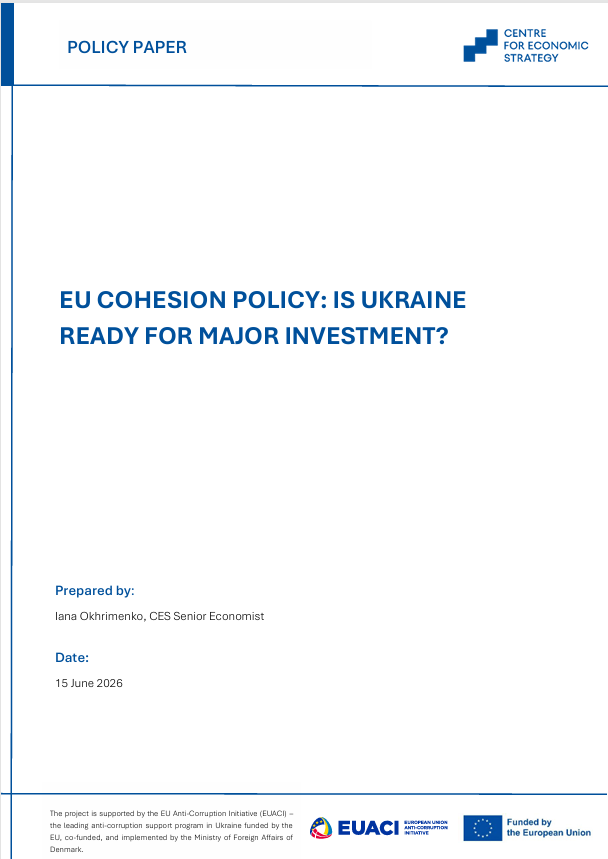
EU cohesion policy: is Ukraine ready for major investment?
Would Ukraine be ready to make effective use of cohesion policy funds if it were to become an EU member soon or gain broader access to instruments based on a similar approach? This is the key question of this study.
Over the past year, Ukraine has taken a significant step in this direction. The system for managing public investment has undergone the most significant changes. From now on, strategies must align with future investment projects and include financial justification, expected outcomes, and measurable indicators. A medium-term plan for priority public investments for 2026–2028 has been introduced. DREAM is taking on a greater role in monitoring projects. Final and post-investment evaluations are also being introduced.
However, to ensure the effective use of cohesion policy funds, separate instruments must be integrated into a single cycle: from strategic planning and project selection to financing, monitoring, auditing and evaluation of results. Public investment management units can improve project preparation, evaluation and monitoring, but they do not replace programme management bodies, intermediate bodies, payment functions, audit and financial correction mechanisms within the CPR framework. DREAM still needs to be integrated with the Treasury, Prozorro, beneficiary registers, GIS and other systems. Checklists and strategy compliance criteria bring Ukraine closer to the enabling conditions approach; however, they currently function as a filter at the document preparation stage rather than as a continuous control mechanism throughout the entire implementation cycle.
Therefore, the answer to the main question is as follows: Ukraine already has some of the necessary rules and tools but does not yet have a fully integrated system for managing cohesion policy funds.
Key recommendations:
- integrate the strategies, the Medium-term public investment plan, the Budget declaration and the future Medium-term fiscal-structural plan into a single cycle;
- make checklists and compliance criteria a permanent monitoring mechanism;
- define a model for managing future EU funds, including programme management bodies, payment functions and audit;
- establish rules on financial corrections and liability for breaches;
- integrate DREAM with other government IT systems;
- strengthen the capacity of local authorities and regions to prepare high-quality projects.
The project is supported by the EU Anti-Corruption Initiative (EUACI) – the leading anti-corruption support program in Ukraine funded by the EU, co-funded, and implemented by the Ministry of Foreign Affairs of Denmark.

Explore more